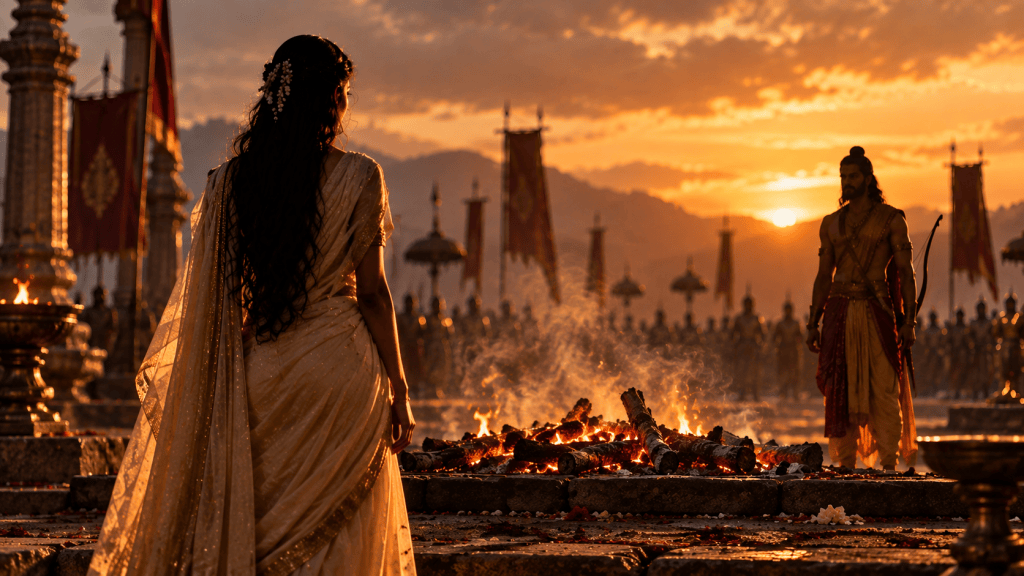
Sita had already defeated fear in Lanka. Now she had to face something far more unexpected: the words of the man she had waited ten months to hear. This is not a retelling. Just a different way of looking at it.
Ten months.
Ten months under an Ashoka tree. Ten months of fruit and plain water. Of walking the same garden until she knew every exit, every guard, every shadow. Ten months of one name holding her upright like an anchor.
Ram.
The crowd parted for her. Vanaras on one side. Rakshasas on the other. Thousands of eyes, and she felt none of them. She saw only the man at the far end. Bow lowered. Battle still dried on his arms. Thinner than her memory. Harder.
She had rehearsed this moment. Under the tree, through the long nights, a hundred different ways. He would run to her. Or he would not run, because he was Ram, and he would walk, and his voice would crack on her name.
He did neither.
“Bhadre,” he said. “You have been won back.”
Won.
She waited for the next word. Sita. Priye. Anything.
“I have defeated the enemy in battle. I have done what human courage demanded of me.” His voice was level. Almost formal. “My indignation is at an end. The outrage against me has been avenged. I have destroyed my enemy and the insult he gave me together.”
The insult.
Something small and cold turned over in her chest. She told herself it was the way warriors spoke after war. He was tired. He was a king before armies.
“Today my prowess has been seen. Today my effort has borne fruit.” And he thanked them. Hanuman, who had crossed an ocean. Sugriva, for his armies and his counsel. Vibhishana, who had walked away from his own brother. One by one, each named for what he had given.
Not one word of it was an accusation. She would remember that later. She would be fair to him even then.
Because somewhere in that list, Sita had started to cry. She did not know when it began. And in the pause between the thanks and whatever came next, she saw it happen. The wife in her saw it first. His eyes left her face. They moved to the crowd. To the thousands watching.
Something in him divided. And the side that turned toward the crowd won.
“What a man must do to wipe away an insult,” Rama said, louder now, to all of them, “I have done. I killed Ravana because I guard my honour. I have recovered you as Agastya conquered the southern quarter, a thing others could not approach.” A breath. “But understand this. The great labour of this war was not undertaken for your sake.”
Sita did not move.
“I did it to protect my name. To silence the accusations against me. To wash away the stain upon my illustrious house.”
Not for your sake.
Her mind found one thought and held it, like a hand on a wall in the dark. He is saying this for them. He is saying this for the crowd.
“Suspicion has fallen on your character,” Rama went on. “And so your presence before me is painful. As a bright lamp is to eyes that are diseased.”
A lamp.
Ten months. She had been called many things in Lanka. Janaka Nandini. Queen. Goddess. Beloved. By the rakshasis, worse. She had borne all of it. She had looked into the eyes of the most feared king in the three worlds and called him a coward to his face.
No one had ever made her feel like a thing that hurt to look at.
“Go,” Rama said. “Wherever you wish. Daughter of Janaka, all ten directions are open to you. I have no further need of you.”
Need.
“What man of honour, born into a great house, would take back a woman who has lived in another man’s home?” His voice did not shake. “Held in Ravana’s lap. Seen by his lustful eyes. How can I take you back?”
Held. Not by choice. Not once, not for a single breath, by choice. He knew that. Surely he knew that. And he did not say otherwise. He only said she had been there, as though being there were itself the crime.
“I recovered you to restore my honour. That is done. I have no attachment to you now. I have decided.” A pause. “Turn your thoughts to Lakshmana, if you wish. Or Bharata. Or Shatrughna. Sugriva. Vibhishana. Choose whatever brings you happiness.”
And then, the last blow, almost gentle.
“Ravana could hardly have endured having you in his house so long without approaching you.”
It wasn’t anger. She knew anger. She had watched it kick over a golden table in Ashoka Vatika. This was something colder. Something that had been thought through. A public, patient rejection, delivered one verse at a time.
Sita folded in on herself. Slowly. As if the body could be made smaller than the words.
Then she wiped her face.
“Had you sent Hanuman with this message,” she said, and her voice came out quiet and terrible, “I would have given up my life then and there.”
And Lakshmana… Lakshmana had not breathed in some time. He stood at the edge of the gathering, and the same scene kept replaying behind his eyes… of a different Rama.
The empty cottage. The brother who had come running, eyes wild, calling her name. Calling it to the trees. To the flowering creepers. To the deer. To the Godavari. Have you seen her? The woman with the beautiful eyes? Is she hiding? Is she playing a game with me? He had even laughed, once, desperately, at the idea. Then the laugh had died, and what came after was worse.
Lakshmana remembered the bow. The breathing. The threat, not against a rakshasa, not against a name, but against everything. The mountains. The oceans. The stars. The gods themselves, if they did not give her back.
He had never seen Rama like that. Never.
And he had stepped forward with folded hands, and he had said what needed to be said. You were gentle once, bhai. Self-controlled. You cared for every living thing. Find the guilty one. Punish him. Do not punish all creation.
It had worked. The bow had come down.
Now the same man stood before him, the same face, the same voice, and said I have no further need of you. And Lakshmana searched for the words. The folded hands. The reminder of who his brother was.
He found nothing.
Because this time Rama was not out of his mind. He was perfectly in it. That was the worst part. Lakshmana understood. The crowd. The throne. The whispers that would follow them to Ayodhya. He understood every reason, and he hated himself for understanding. And he had heard his own name offered up. Turn your thoughts to Lakshmana. To her.
He looked at the ground. He looked at Sita. He could not look at his brother.
“Lakshman.”
Her voice. Calm. Hollow, like a bell after it has stopped ringing.
“Build me a pyre.”
No.
The word rose in him so fast it burned. He had said it once before, in a forest, with folded hands, to this same man. Not this, bhai. Not like this. And it had worked. It had always worked.
He turned to Rama. He waited for a word. A sign. A flicker of the man who had asked the river for her. Anything that would give him the strength to say it again.
Rama’s eyes stayed on the ground. He said nothing.
Lakshmana’s gaze dropped to her feet. Bare. Dusty. Ten months of Lanka’s garden on them. Once, on a mountain, a vanara had opened a bundle of her jewels, and he had not known a single one. Not the bangles. Not the necklace. Only the anklets. Because those, he had seen every morning for fourteen years, bowing at her feet.
Maa.
And now she was asking him to build the fire those feet would walk into.
Fourteen years. Fourteen years of following his brother into forests, carrying his bow, keeping watch while he slept. Never once had he disobeyed him. He had always thought of it as loyalty.
He had never known it could be something he did with his own hands.
He went to gather the wood. Each log was heavier than the last.
And Sita waited for the pyre to be built. Rama had offered her many paths. Go anywhere. Go to anyone. Go. She took none of them.
She walked toward the flames in silence. Not once did she look back at the man who had spoken. The fire rose around her, gold and unforgiving, and the crowd that had watched her humiliation held its breath. And she stepped in.
She did not ask the world to believe her. She did not ask him. She put the only decision that still belonged to her into the fire.
Whether Rama had foreseen it, Valmiki does not say. But for one long moment, the sovereign who had directed every step of the conversation could only stand there and watch.
Then Agni rose.
He carried her out in his own arms. Unburnt. Radiant. He set her before Rama and spoke to the whole assembly. She had been faithful in thought, in word, in deed. Ravana had taken her against her will. She had resisted every threat and every temptation. She had remained devoted to Rama alone.
“Take her,” Agni said. “And do not speak harshly to her.”
Rama’s eyes filled. Tears of joy, Valmiki says. He was quiet for a while. And then he began to explain.
“I know Sita is undivided in her affection for me,” he said. “Ravana could no more violate her, protected by her own spiritual strength, than the ocean could cross its shore.”
Sita listened.
“But she had lived so long in Ravana’s house. Her purity needed to be shown to the world. If I had taken her back without this, they would call Dasharatha’s son a fool, a man so ruled by desire for his wife that he ignored every question about her.”
He spoke of her as sunlight is to the sun. Inseparable. Hers, and his.
He knew.
She had waited ten months for him. Through the threats, the insults, the long nights beneath the Ashoka tree. She had imagined his face. His voice. The moment she would hear him say her name again.
She had never imagined having to prove herself to him.
And now he was telling her that she hadn’t needed to.
Sita looked at Rama.
There was no anger left in her eyes. No accusation. No plea for him to understand what his words had done. She had said what she needed to say before entering the fire. Agni had said the rest.
Rama had his answer. The world had its answer. She had hers too.
Not about her purity. That had never been a question to her. About something she had never thought to question.
She lowered her eyes.
She still loved him.
But the certainty she had once held in his love had not come out of the fire with her.
************
We have spent centuries debating those words. Did they belong to a husband, or to a sovereign? But Sita never had the luxury of that distinction. She heard only one voice. The voice of the man she had waited ten months to hear.
Agni returned Sita to Rama. Whether he could return everything the fire had taken from their reunion is a question Valmiki leaves us to consider.


Leave a Reply