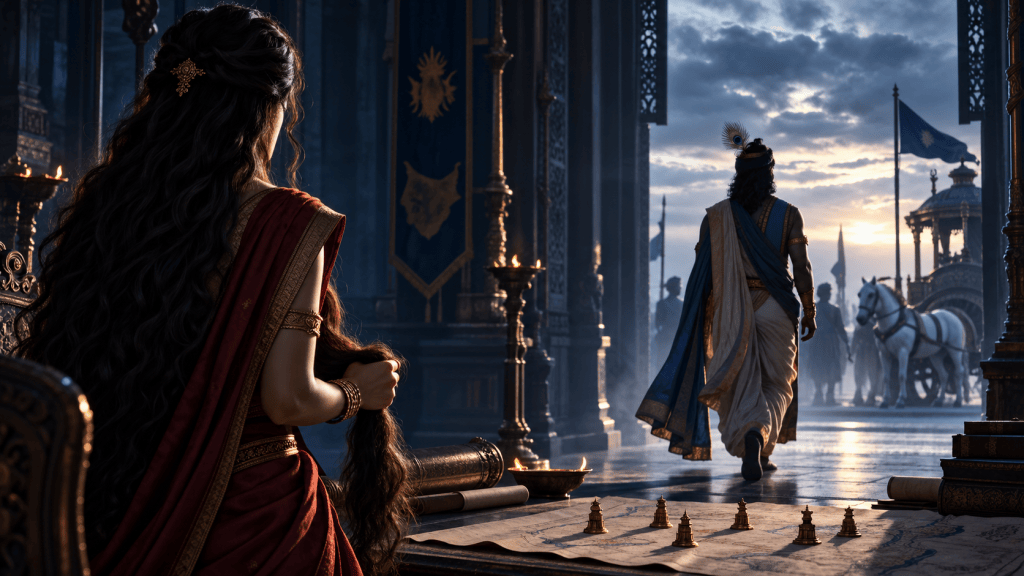
Everyone remembers the peace mission as Krishna’s last attempt at peace, the one that failed. But what if the real question was asked before he ever left?
The Mahabharata tells us what Draupadi said before Krishna left for Hastinapura. But sometimes, to understand a conversation, I need to stand inside the room where it happened.
*****
Five villages.
The words had been spoken so many times in the council that they no longer sounded like a demand. They sounded like a prayer. Avisthala. Vrikasthala. Makandi. Varanavata. And one more, whichever Duryodhana cared to name.
“Five,” Yudhishthira said again, quietly. “Let the Kurus live. What was done in that assembly…” A pause. Barely a breath. “The dice. The insults. The thirteen years. We will bear all of it. All of us. If that is the price of keeping this family alive, we will bear it.”
We.
Krishna sat very still. He had not said what he expected. He had not said that Duryodhana was already reading the offer as weakness, that Shakuni was already counting the days, that Karna’s loyalty had hardened into something no argument would soften. He had only listened.
Bhima stood by the pillar. The man who had once sworn to tear open Dushasana’s chest and drink what poured out. To break Duryodhana’s thigh. His jaw worked. His fists opened…slowly…and closed again.
“If this saves the Kurus,” he said, and the words seemed to cost him something, “I will swallow my vow.”
Arjuna did not argue. He rarely did, when Krishna was in the room. “Do what you think is best, Madhava.”
Everyone had a reason. And they were good reasons. That was the horror of it. If five villages could stop what was coming, then of course. Take the five villages.
Behind the carved lattice, Draupadi had stopped breathing at swallow my vow.
Her fingers had found her hair. They always did. A long, heavy, unbound rope of it, down to her knees. Thirteen years it had hung loose. Thirteen years of Hastinapura’s dust and the forest’s rain and the dry winds of Virata’s kitchens. She had not let anyone tie it. Not Subhadra. Not her own maids. Not her own hands, on the nights she had sat with the comb and could not do it.
Bhima.
Not Yudhishthira. She had expected it of Yudhishthira. Somewhere in the long years she had made her peace with the fact that her eldest husband’s dharma had no room in it for her fury. But Bhima. Bhima who had shaken in that hall like a mountain about to break. Bhima who had held her afterward in the dark, hands trembling, saying I will not forget. I will not forget.
Swallow my vow.
She leaned her forehead against the cool wood. And the hall came back. It always came.
The hand in her hair. Not a pull. A seizing. The floor scraping her knees. The laughter. So much laughter. Men she had served with her own hands, who had called her bhabhi and Panchali and queen, laughing. The silence of the elders, as heavy as stone. The cloth in Dushasana’s fist, and the sound of her own voice asking a question no one in that hall had the courage to answer.
Yajnaseni did not beg. Not once. Not for the cloth, not for her husbands, not for a single man in that hall. She had asked about law. About whether a man who had already lost himself could stake her.
And in her heart, where no one could hear, she had called for the only one who was not there.
Krishna. Save me.
He had. In his way, in his time. And she had never decided whether she loved him for it or hated him for the wait.
She noticed, absurdly, that her palms were wet. She noticed that Yudhishthira had said we. She noticed that she would remember that he had said we.
The petty thought steadied her. It was hers. It meant she was still herself. She lifted her chin. She gathered her hair, the whole heavy length of it, into her fist.
And she walked in.
The room did not go silent all at once. It went silent in pieces. Satyaki first, then the Panchala princes, then the brothers. Last of all, Yudhishthira, who looked up from the map and saw her, and for one moment looked like a man who had done a sum and just realized he had left something out.
She did not look at him. She looked at Krishna.
“Govind. You are going to Hastinapura.”
“I am.”
“For peace.”
“If it can be had.”
“Then hear me first.” Her voice was low. Level. She had practiced nothing, and yet every word came in order, like arrows from a quiver she had been filling for thirteen years. “Duryodhana took our kingdom through deceit. Through dice. Through Shakuni. That is not a war the Pandavas started. You know it.”
“I know it.”
“Yudhishthira has come down. From the whole kingdom, to half. From half, to five villages. And still we stand here wondering whether Duryodhana will give even that.” She let the words reach every single person in that room. “So if the peace you carry is a peace in which Duryodhana keeps everything, then do not go. Do not insult the dead of this family by asking for it.”
A murmur. Someone shifted. Yudhishthira opened his mouth.
She turned her eyes on him, and he closed it.
“They will say mercy is dharma,” she said. “That forgiveness is the highest thing. Perhaps it is. There is sin in killing a man who does not deserve to die, Govind. And there is sin in letting a man live who does not deserve it. If you spare the one who dragged a woman into an assembly, you have not been merciful. You have simply decided who is allowed to pay.”
The room had gone very still.
Her grip on her hair tightened. She had not planned any speech. Had no intention of appealing to anyone. She just…spoke.
“I am Drupada’s daughter,” she said. “Born from the sacrificial fire. Dhrishtadyumna’s sister. Pandu’s daughter-in-law. Wife to five men who shine like Indra. Mother to five sons who carry the Pandava name.”
Each one landed like a stone dropped into water. She watched the ripples cross their faces.
“And with all of that…” Something cracked. Quietly. In the exact center of her voice. “With a father, and a brother, and five husbands, and five sons, and a dynasty behind me…I was dragged by this.” She held up her fist, the hair wound tight. “Into a hall full of men. While every one of them was alive.”
Her breath caught. She pushed through it.
“What did all that protection amount to? What did it do? I called out to you, Krishna. In my heart. When my husbands sat there with their heads bowed, I called out to you. And I was the one who used the boon of the blind king to free my husbands from slavery.” Her eyes found Arjuna. “Fie on Partha’s bow. Fie on Bhima’s strength. If the man who did this to me still walks free, what is it for?“
Arjuna looked down. Bhima did not. Bhima looked at her as if she had struck him, and did not look away, and she loved him for it, and she did not stop.
“When you speak to Duryodhana, Krishna…when you speak of villages, of peace, of saving the Kurus…” She stepped forward. She lifted her hair like an offering, like an accusation, like the only thing she had left. “Remember this.”
The tears came then. She did not stop them, and she did not hide them. They came hot, and her voice shook, and her shoulders shook, and still she did not lower her hand.
“If my husbands want peace, let them have it. My father will fight. My brothers will fight. My sons will fight. Abhimanyu will fight. I do not need anyone’s permission.” She dragged in a breath that sounded like it hurt. “Thirteen years. I have carried this fire for thirteen years, and you ask me how my heart can know peace? How? When I have not yet seen the arm that seized me lie broken on the ground?”
She was sobbing now, openly, helplessly, and she was still the most terrifying person in the room.
“I am not asking you for a war, Govinda.” Softer. Wrecked. “I am asking you not to bring me a peace that needs me to pretend nothing happened.”
Nobody spoke.
Yudhishthira’s hands lay open on his knees. For the first time, he had nothing to say. Bhima was staring at the floor as though it might swallow him.
Krishna rose. He crossed the room. He did not hurry. And when he reached her, he did not tell her to forgive. He did not speak of the thousands who would die. He did not say that Yudhishthira had spoken for all of them.
He let her cry.
He stood there and let her weep until she had no more weeping left, and nobody in that room dared to look away.
Only then did he speak. “Sakhi.”
A pause.
“The women of the Bharata house will weep as you weep now.” Quiet. Final. “The men against whom your anger burns will fall. With Bhima and Arjuna, with the twins, under Yudhishthira’s command, it will be done.”
Her breath hitched. Steadied.
“I will go to Hastinapura. I will try. Because it must be tried. But hear this.” And now there was iron under the gentleness. “The mountains may move. The earth may split. The stars may fall from the sky. My word will not prove false.”
He did not promise her peace. He did not promise her war.
He promised her that he had not forgotten.
*****
Krishna left. In one hand, he carried the offer of five villages. In the other, something that did not fit beside it, and that he had no intention of putting down. Behind him, in a quiet hall, a woman stood with her hair still wound around her fist.
And a question that peace had not answered.
When everyone has something to gain from peace, what happens to the person who is being asked to pay for it?


Leave a comment