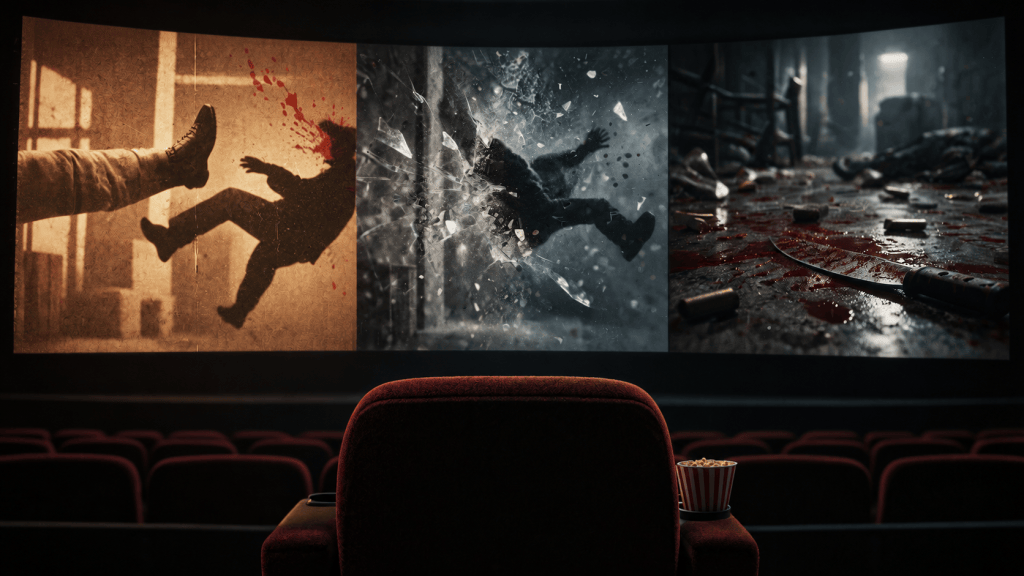
Last week I decided to revisit Jagadeka Veerudu Athiloka Sundari. A 90s superhit. A film I loved as a kid, and one that lived rent-free in my head for years, specifically the fights. Somewhere in my younger self’s running commentary, there would have been an enthusiastic “Chiru em shot kottadu ra!” every time Chiranjeevi sent another villain airborne.
Watching those same fights now, I laughed. Not the way they intended.
Punches sent men sailing through the air like they’d personally wronged gravity. Bodies absorbed damage with the resilience of a Nokia 3310. And the blood…well, there was plenty of it, and it occasionally appeared in a shade of orange that raised questions no one on set seems to have asked.
None of that bothered me back then.
Raju had a reason to fight. Swamiji had given us every reason to want him gone. There was anger, danger, and emotion behind those punches, and I cheered for the man throwing them because I cared about why he was throwing them. And apparently, I also found the punches themselves genuinely impressive.
So what changed?
The film hasn’t. I have.
Or maybe cinema and I changed together, and I only noticed my half of it just now.
We Knew It Wasn’t Real. That Was Never the Point.
This isn’t a Chiranjeevi problem. Amitabh, Dharmendra, Sunny Deol, Rajinikanth…through the 80s and 90s, North and South both ran on the same grammar of violence, and audiences didn’t just tolerate it. They erupted for it.
The dishoom. The hero absorbing six punches and then, with great dignity, wiping a single suspiciously bright streak of blood from his lip. The villain flying considerably farther than the force applied to him could possibly justify. Rajinikanth doing things for which physics had not granted prior approval, and never seemed inclined to.
We knew none of it was real. Realism was never what we were there for.
The punch was the payoff. The villain had crossed the line, the hero had finally had enough, and when the fist landed, we weren’t calculating force and velocity. We were cheering because the man deserved to be hit.
But the craft kept moving.
Better choreography. Better prosthetics. Better sound design. Better cameras. More exposure to action cinema from other industries and other countries, all bleeding into what we expected on our own screens. Somewhere in that climb, action stopped being only about showing you the punch and started showing you what the punch does.
And we moved right along with it.
What impressed us in 1990 doesn’t necessarily impress us in 2026 because we’ve simply seen too much since. Our visual vocabulary got bigger. Our threshold went up. So cinema raised the stakes.
Then we got used to those stakes.
So cinema raised them again.
It’s a strange little partnership when you think about it. Cinema shows us more. We become accustomed to more. Filmmakers have to find another way to make us gasp, cheer or flinch. We get accustomed to that too.
And every generation thinks the previous one’s idea of great action is slightly ridiculous.
We now watch some of the fights we once cheered and laugh. Gen Z watches us watching them and gives us that pitying look that says, You guys actually enjoyed this?
Yes, child. We did. Very much. Stop judging.
Your turn will come.
Which is how I ended up sitting with the question: When did violence stop needing to hurt us, and start needing to impress us?
I decided to test that question against the violent scenes that have actually stayed with me.
Then My Own Movie List Ruined My Theory
That was my first mistake. Because they refused to cooperate.
Agneepath gave me Deenanath Chauhan’s death, but what stayed with me wasn’t the mechanics of the killing. It was young Vijay being forced to watch his father die.
Delhi Crime barely needed to show me anything. A girl narrating what was done to her made me feel physically sick, perhaps because I knew that beneath the performance was something that had actually happened.
Temper got me from two directions at once. The girl’s fear felt real even through those hazy video clips. But I was also watching Daya watch them. This was the cop who had taken money and released those men. When her mother came looking for her, he had casually dismissed her with a story about her daughter having an affair and running away. Then he sees the video. Her fear gives the scene its horror. His guilt gives it consequence.
Dasara needed seconds. Suri and Dharani are escaping on a cycle. Suri is pedalling, Dharani is behind him. Then silence. And suddenly Suri’s head is just…gone.
No elaborate buildup. No prolonged death scene. One moment he’s there, the next he isn’t. I felt exactly what Dharani seemed to feel when he first saw his friend without a head.
Then there was RRR, which cheerfully destroyed another possible theory.
Maybe I had simply outgrown unrealistic action? Yeah. No.
There are moments in RRR where physics doesn’t bend so much as pack its bags and leave.
And I loved them.
The interval fight had me hooting, whistling and eventually counting hits because it started feeling like watching an equation get balanced. Two superstars. Rajamouli has to make sure neither side gets one punch more than the other, or there will be war among the respective fanbases.
But underneath all that spectacle was pain.
Neither Ram nor Bheem is wrong. Neither wants to hurt the other. Both have reasons they cannot walk away. So every punch I was cheering also hurt someone I didn’t want hurt.
And that was when my original question started falling apart. Because violence clearly hadn’t stopped needing to hurt me.
It was doing both.
Maybe “violence” in cinema isn’t one thing at all.
What’s Actually Hiding Under the Word “Violence”
Sometimes it is consequence.
The act matters because of what it does to someone.
Young Vijay watching his father die. Daya discovering what his corruption helped unleash. A child in RRR keeping the promise he made to his father, taking aim and blowing that same father to pieces. No tears. The trauma is too deep for tears.
Sometimes it is spectacle.
And I don’t mean that as an insult.
A beautifully choreographed action sequence can be pure cinematic pleasure. Timing, movement, sound, scale, editing. The same part of your brain that appreciates a well-executed dance sequence can appreciate a fight designed down to the last punch.
RRR proves spectacle and emotion don’t even have to compete. You can whistle and hurt at the same time.
And sometimes violence is simply sensation.
How do we make this one hit harder than the last?
Babu Dakait’s death in Dhurandhar got exactly what it wanted from me. Holy crap. Did he really just smash the guy’s head in?!
Pure shock.
Nothing wrong with that either. Sometimes a filmmaker wants you to recoil, and you recoil.
The problem begins when the film needs the next death to produce an even bigger holy crap. And then the next. And the next.
Because at some point, something odd happens. The holy crap stops getting bigger.
Dhurandhar: The Revenge actually gave me two very different reactions in two different scenes, and it took me a while to work out why they didn’t feel the same. Arshad Pappu’s death got the same holy crap out of me that Babu Dakait’s had. But this time it curdled into something else almost immediately: wait a minute, didn’t some version of this actually happen in reality? The shock stopped being about what I was watching and started being about what I might actually be remembering. That’s not quite sensation and it’s not quite consequence either. It’s a third thing violence can do to you: make fiction and memory blur into each other so you’re no longer sure which one is unsettling you.
When Shock Turns Into Exhaustion
Kill was probably where I noticed it most clearly.
Initially, the violence was both thrilling and disturbing. Then there was more. And more. Eventually I wasn’t more horrified.
I was tired.
HIT: The 3rd Case did something similar. I genuinely found the story interesting and the plot unique. But by the final fight, all that slaughter had become so dominant that the story underneath it almost disappeared.
The violence had eaten the very thing that gave it a reason to exist.
And then came Dhurandhar: The Revenge again, this time for Major Iqbal.
The last forty minutes exhausted me. By then everyone knew everything. There was nothing left to discover. It was blasting, killing, chopping and settling scores.
When Major Iqbal’s turn finally came, his leg was chopped off. And I caught myself thinking: Okay, enough now. Kill him and move on.
Which is a fairly alarming response to watching a man lose a limb.
The strange thing is, I was still paying attention to Iqbal.
A part of me actually appreciated that he didn’t plead for his life or cry in agony. It would have felt wrong for the character. His consistency remained intact right till the end.
So I hadn’t disengaged from the character. I’d disengaged from the violence. That’s the part I keep coming back to.
If a severed limb can make me impatient, while a child being forced to watch his father die in Agneepath can still gut me, then surely the amount of blood isn’t what decides how violent something feels.
There seems to be a saturation point.
Shock. Horror. Adrenaline. More shock. More blood. More bodies.
And somewhere along the way: Enough.
The editor could have cut twenty minutes from that final stretch and I don’t think I would have missed anything. Character consistency would still have been there. The story would still have reached the same place. The body count would merely have arrived faster.
Maybe We Helped Create This
It would be easy to point at filmmakers and ask why everything has to be bigger, louder, bloodier.
Except I’m not sure we get to wash our hands of it that easily.
We were the people who cheered when Amitabh landed the punch. We whistled for Chiranjeevi. We accepted Rajinikanth’s ongoing personal disagreement with physics.
Then we saw better fights. Better choreography. More realistic impacts. More blood. More graphic injuries. More elaborate ways of killing people.
And every time cinema expanded what it could show us, we absorbed that new visual language and adjusted our expectations.
Yesterday’s Whoa! becomes today’s I’ve seen that.
So the filmmaker goes looking for tomorrow’s Whoa!
Maybe cinema hasn’t simply been training its audience.
Maybe we’ve been training each other.
Which also means I don’t think this is a journey from fake action to realistic action.
RRR alone destroys that argument.
We will still happily accept something completely impossible if the film convinces us to accept it. We don’t need physics. We need the cinematic contract to work.
The old Chiranjeevi fight worked for the audience sitting in that theatre then.
The RRR interval fight works for me now.
Different visual languages. Same willingness to surrender disbelief.
So, Did Cinema Get More Violent? Wrong Question.
I started with: When did violence stop needing to hurt us, and start needing to impress us?
I’m no longer sure it ever stopped.
Cinema still knows how to hurt us.
Delhi Crime barely showed me the act and made me nauseous.
Dasara needed one cut.
Agneepath needed a child watching.
RRR managed to make me whistle while two people I cared about beat the hell out of each other.
And yes, cinema also knows how to impress us with violence. It always has. The tools have simply become much better.
The problem isn’t spectacle. It isn’t gore either. Sometimes brutality needs to look brutal. Sanitising it would defeat the point.
The problem begins when a film keeps escalating the physical violence without escalating what that violence means. More blood doesn’t automatically create more horror. More bodies don’t automatically raise the stakes. A longer fight doesn’t automatically become more exciting.
And showing me exactly what happens to a human body doesn’t automatically make me care about the human being inside it.
Perhaps violence never stopped needing to hurt us.
Filmmakers simply have more tools than ever to make it hurt, and more tools than ever to make us notice.
The trouble begins when one gets mistaken for the other.
I still love the dishoom.
I just laugh a little more at it now.
That feels like a fair trade.


Leave a comment