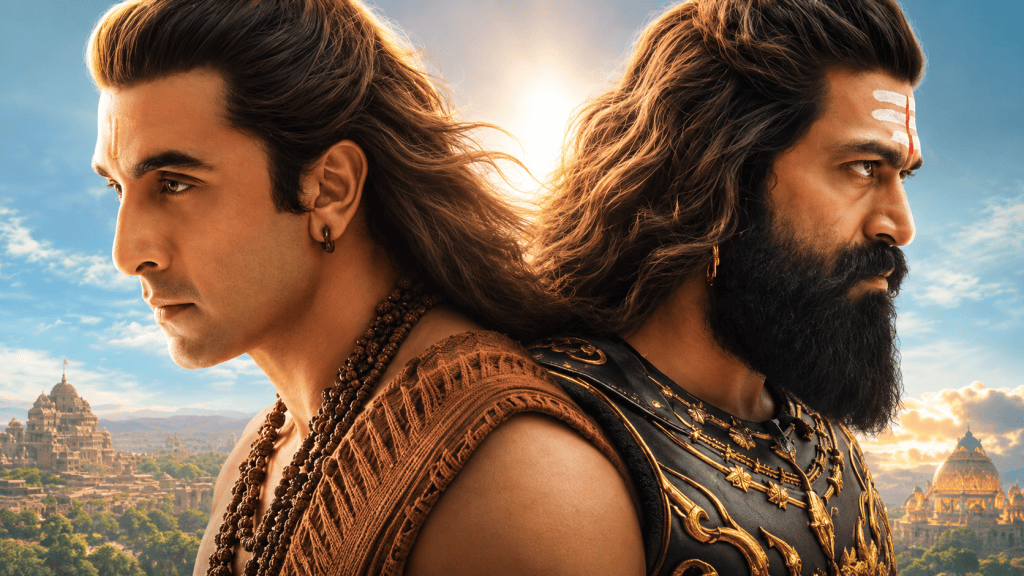
Some films overwhelm you. Some disappoint you. And then there are the ones that leave you wondering why you admired so much of what you saw, yet felt so little.
I walked into Ramayan with reservations. Ranbir Kapoor as Rama, mostly. The casting, the scale, and the nagging question of whether another adaptation of an epic we’ve known since childhood could offer anything beyond familiar scenes in expensive visual effects.
I walked out with a more unexpected problem.
I was invested in the story. Just not in the man at its centre. And somewhere along the way, I understood why people had started calling it Raavana-yanam.
They weren’t entirely wrong. The nickname stopped sounding like a joke and started sounding like a review.
The Man Who Knew, and the Prince Who Didn’t
This Ramayan is, in many ways, a story about the asuras, and about the ordinary prince of Ayodhya destined to bring them down.
Raavan knows the larger game. He knows the history of the devas and asuras, and that Vishnu has stepped in for the devas before. He knows Brahma’s protection has a loophole: humans were left out of his request because he thought them incapable of threatening him. And when he hears that certain sages believe Rama may be Vishnu in human form, he doesn’t wave it away.
He understands it. He simply believes he can beat it.
That distinction is what makes this Raavan interesting. He isn’t an ignorant villain blundering toward a fate the audience can already see. He is an intelligent, powerful man who recognises the danger and lets arrogance overrule intelligence.
The film gives that conflict a voice. Ten, in fact. Instead of ten physical heads, we see ten versions of Raavan arguing among themselves: pride, vengeance, ambition, wounded ego, wisdom. One warns him about Rama, about the destruction of Khara, Dushana and thousands of asuras, about the very human vulnerability he arrogantly overlooked.
Raavan hears the warning. And chooses not to listen.
Ten voices in one head, and the sensible one still loses the vote.
Notice what has happened here. Normally the audience is the one who knows. We watch the villain walk toward a destiny we can see and he cannot. In this film, the knowledge has quietly changed hands. Raavan knows. We know. Rama doesn’t.
A man who walks knowingly toward his destruction is far more compelling than one who never sees it coming. He is choosing at every step, and choices are what drama is made of.
Meanwhile, Rama knows almost nothing of this. He is a prince. A capable warrior, a gentle son, a loving husband, a protective brother. He goes where duty takes him, accepts what destiny places before him, and shows no awareness of his divine identity.
I actually liked that choice. Rama doesn’t have to radiate divinity for us to understand who he is. There is something appealing about a man who lives by his principles without knowing the cosmic weight of his existence.
The trouble isn’t Rama’s acceptance of destiny. It’s how little time the film spends showing us what that acceptance demands of him.. And the filmmakers spend considerable time showing us how Raavan became Raavan, while expecting us to already know how Rama became Rama.
Raavan gets a story. Rama gets a summary.
That imbalance follows the film almost to its end.
The Mother Behind the Monster
One of the film’s strongest choices is Kaikasi.
Shobhana was a casting decision I questioned. I couldn’t imagine her as the formidable mother of Raavan.
I was wrong.
We see Kaikasi as a warrior, fighting alongside her father, witnessing defeat, humiliation and the loss of Lanka. We see the asuras driven into Patal Lok, struggling to survive. And then we see her son. A young Raavan, absorbed in his veena. Not a conqueror. Not a monster. A scholarly young man who loves knowledge and music.
Kaikasi sees something else. She sees the son she deliberately brought into the world, born of a sage’s knowledge and an asura’s strength, a son who could reclaim what her people lost. She reminds him of their suffering and demands he fulfil the purpose for which he was born.
It’s a fascinating glimpse into the making of a conqueror. Not because it absolves Raavan. It doesn’t. But because it shows how ambition can begin as a response to injustice, how a wish to protect one’s people can harden into a hunger for supremacy, and how a mother’s determination can shape a son’s destiny.
Shobhana brings remarkable conviction to that transformation. And Yash carries it forward.
I had wondered whether his comparatively lean physique would work for the mighty ruler of Lanka. The camera, the styling, his presence and Sharad Kelkar’s commanding voice settled that question quickly.
I stopped seeing Yash. I saw Raavan.
That, to me, is what successful casting should do.
Rama, Rama… Where Art Thou?
Ranbir Kapoor surprised me. Not completely. But enough for me to admit that my reservations weren’t entirely justified.
As the gentle prince of Ayodhya, he works better than I expected. His Rama is courteous, restrained, humble, compassionate. Even when killing Tataka, he seeks forgiveness before releasing the arrow. Taking a woman’s life, even a demon’s, does not sit easily with him. That soft “Kshama” before the arrow tells us something important about who he is.
So does a fleeting childhood scene in which he watches Kaushalya’s pain as Dasaratha spends time with another wife. Later, when he promises Janaka that Sita will be the only woman in his life, the connection is there. It’s one of the few threads of Rama’s inner life the film plants carefully, and it pays off later with Surpanakha.
But it passes so quickly that the significance could easily escape the viewer.
And that is my recurring frustration. Rama’s birth, childhood, marriage, the breaking of Shiva’s bow, and the circumstances leading to his exile are hurried through as though the filmmakers are ticking off a list of events everyone already knows.
Knowing an event and experiencing it are two very different things. The film understands that distinction perfectly when it comes to Raavan. With Rama, it keeps forgetting.
Ranbir has another problem. His expressions don’t always carry the weight of the character. His smiles occasionally feel awkward, and the commanding presence required in the larger moments remains elusive.
Then comes Parashurama.
Oh dear.
Changing an actor’s attire, adding a beard and applying some vibhuti does not create Parashurama. That is a costume, not a character. Parashurama’s fury is not an accessory. His eyes, his bearing, his very presence should carry the terrifying intensity of a man whose anger has shaped his existence.
What I got was an expression best described as a facepalm. Mine, I mean. And I suspect it said considerably more than the screenplay intended.
Sita Deserved Better
Sai Pallavi as Sita was my biggest casting disappointment. And no, not because I expected some impossibly beautiful, perpetually serene princess.
Sita is far more than that. She has intelligence, conviction, courage, and a moral clarity that deserves to be visible in her portrayal. The film even tries to present her as a warrior, capable with a sword. The performance and presentation never convinced me.
The sword handling was awkward. The costume seemed entirely unsuited to the movements expected of her. The never-tucked-in sari pallu makes a lovely shot. It makes a poor battle plan. And running with a sword needs a little more conviction than running to hand someone a water bottle.
The excessive blush, the styling, the carefully arranged smiles: all of it gave us a Sita more conscious of appearing like Sita than simply being her.
And the chemistry between Ranbir and Sai Pallavi? There wasn’t any.
The Abduction the Film Skipped
Interestingly, the film handles the moments leading up to Sita’s abduction with considerable intelligence.
Lakshman’s ability to create the Rekha is explained. Raavan’s disguise as a sage is convincing. And Sita doesn’t blindly trust the stranger at her doorstep. She questions him, demands that he recite a particular Vedic stanza to prove who he is, and lowers her guard only when he passes.
It’s a clever sequence. Raavan is a genuine scholar, so passing her test is hardly difficult. And Sita’s suspicion makes her eventual deception more believable, not less.
But then, inexplicably, the film skips the abduction itself.
One moment, Sita is interrogating a supposed sage on his Vedic credentials. The next, she’s aboard the Pushpak Vimana.
How did Raavan actually take her? What happened when she realised the deception? Why build the entire sequence so carefully, only to leave out the moment it was building toward?
For a film willing to spend so long on Raavan’s motivations, it’s a curious omission. We get the lead-up and the aftermath. We never get the scene itself… the moment when the prince’s wife, the warrior the film insists she is, discovers that the sage standing before her is the villain who knows everything.
Raavan gets a story. Sita gets a jump cut.
The Supporting Characters Who Found Their Footing
Lakshman was a genuine pleasure. Fiercely protective of his brother and sister-in-law, quick-tempered, affectionate, with just enough mischief in his eyes to feel like a younger brother rather than Rama’s obedient shadow. Their relationship worked, largely because of the energy he brought to it.
Rakul Preet Singh’s Surpanakha was a pleasant discovery. She isn’t introduced as a grotesque creature whose desire is inherently laughable. She is confident, attractive, direct and unapologetic about what she wants. She approaches Rama, states her interest, and even points out that his father had three wives. Why shouldn’t Rama consider another?
Rama declines, citing his promise to Sita. What follows is wounded pride, deception and humiliation, ending in Lakshman’s decision to cut off her nose. The scene gives Surpanakha more personality than most adaptations allow her. And Sita’s subsequent objection raises an uncomfortable question about punishment and consequence.
Lara Dutta’s Kaikeyi, however, lacked the intensity I expected, particularly when demanding her boons. Bharat didn’t leave much of an impression either, and the absence of a meaningful confrontation between mother and son after Rama’s exile felt like another missed opportunity.
Once again, some characters were allowed to live their stories. Others were hurried through them.
When the Music Felt More Than the Performances
The action deserves appreciation. Rama and Lakshman don’t simply stand in place and release arrows. They move, pursue, fight with swords, in combat that feels considerably more dynamic than the visual language of many earlier adaptations. The forest armour, apparently fashioned from cane or something like it, was a clever detail.
The battle between Jatayu and Raavan was spectacular. The choreography, the scale, the moment Jatayu beheads Raavan only for the head to return: a remarkable sequence.
But spectacular is not the same as emotional. I admired the scene. I wasn’t moved by it. That distinction extends to much of the film.
Hans Zimmer’s score is its greatest strength. He seems to understand the emotional identity of every sequence. Fury has a sound. Arrogance has a sound. Pain, battle, grandeur, menace: each finds its own musical expression. The score doesn’t merely accompany the story. It participates in it.
A. R. Rahman’s songs, unfortunately, left me cold. They seemed present because a film of this scale was expected to have songs, not because the music had something essential to say. Not one melody stayed with me.
Two composers, one film, and only one of them seemed to have read the room.
The Promise of a War
After Jatayu’s death, Rama finally stops accepting whatever destiny places before him.
He knows Raavan is powerful. He knows Lanka is formidable. He knows the enemy he means to face is believed to be nearly indestructible. And he doesn’t care. He will go to Lanka. He will destroy Raavan. And if Raavan rules the three worlds, those three worlds will witness his destruction.
This is the first time the film lets Rama choose instead of accept. It should have been the hinge of the whole story: the moment grief, love, fury and resolve converged, and Rama’s presence finally matched the scale of everything around him.
The words were there. The music was there. Zimmer gave the moment tremendous force.
But Ranbir didn’t quite carry it. I heard the declaration. I understood its significance.
I didn’t feel the transformation.
And that worries me about Part 2. The Rama who must lead armies, confront Raavan and carry the emotional and moral weight of the coming war will need considerably more than the gentle prince we’ve seen so far.
A Story That Held Me Without Moving Me
Perhaps that is the strangest thing about my experience of Ramayan.
I liked its ambition. I appreciated the decision to explore the asuras beyond their familiar roles as villains. I admired how Kaikasi and Raavan were developed, the intelligence behind certain narrative choices, the action choreography, and the extraordinary contribution of Zimmer’s score. I even appreciated the decision to portray Rama as an ordinary prince who doesn’t know he is extraordinary.
But I was rarely emotionally involved. And for the Ramayana, that is no small thing.
This is a story built on relationships, choices, sacrifices, love, loyalty, grief and duty. The spectacle can be magnificent. The battles can shake the theatre. The music can make the walls tremble. None of that replaces the quiet connection between characters and audience.
The film gave me plenty to admire. It gave me far less to feel.
Yet I want to watch Part 2. Not merely to see whether Ranbir Kapoor can prove me wrong, although I sincerely hope he does. I want to see where this interpretation goes. I want to see what happens when the prince who knows nothing of the larger conflict finally confronts the king who has known about it all along.
And perhaps that is the film’s greatest achievement… and its greatest risk.
It has made Raavan so compelling that Rama now has to catch up.
The first part told me why Raavan became the man he is. The second must make me feel why Rama is the man who can defeat him.
Until then, I remain intrigued. Impressed.
And still waiting to be moved.


Leave a Reply