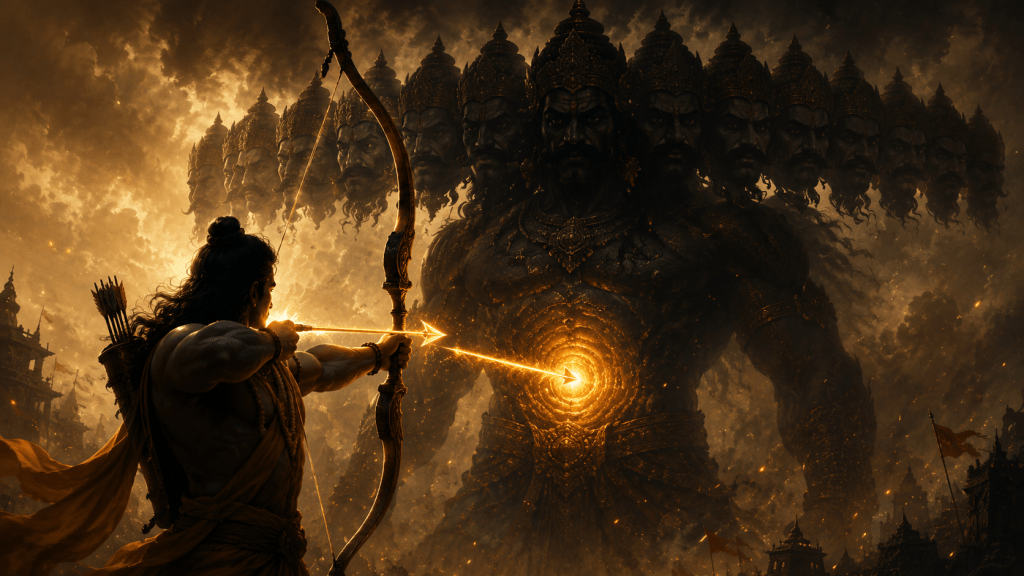
We often hear that Raavan had ten heads.
Some versions describe them as symbols of immense knowledge – the four Vedas and six Shastras. Others interpret them as the ten inner forces that govern human nature:
Kama, Krodha, Moha, Lobha, Mada, Matsarya, Manas, Buddhi, Chitta, and Ahamkara.
But if the heads were symbolic… why does the epic describe Rama repeatedly cutting them down during the war, only for them to return again and again?
Perhaps because some truths are easier understood through image than philosophy.
Explaining how ego revives anger, how desire strengthens pride, or how delusion keeps corruption alive is not simple. But a warrior fighting a demon whose heads keep regenerating?
That image stays. And perhaps that is the point.
- Kama (Desire) – Cut desire… Moha revives it.
Because delusion whispers: “This is not lust. This is love. This is destiny.”
- Krodha (Anger) – Suppress anger… and Ahamkara breathes life back into it.
Because ego cannot tolerate insult. “How dare they?”
- Moha (Delusion) – Destroy delusion… and Mada rises quietly beside it.
Because pride refuses to accept the possibility of being wrong. “You cannot possibly be mistaken.”
- Lobha (Greed) – Cut greed… and Matsarya returns sharper than before.
Because envy cannot bear another possessing what it lacks. “Why should they have what you desire?”
- Mada (Pride) – Silence pride… and Kama seduces it back to life.
“Win. Possess. Mine.”
- Matsarya (Jealousy) – Crush jealousy… and Lobha transforms comparison into hunger.
“Take what should have been yours.”
- Manas (Mind) – Calm restless thought… and Chitta gives it direction.
A passing impulse becomes an obsession.
- Buddhi (Intellect) – Corrupt intellect… and Ahamkara reshapes its purpose entirely.
The mind stops asking: “Is this right?” And begins asking: “How do I justify this?”
- Chitta (Will) – Break the will… and Moha gives it purpose once more.
“This matters. Pursue it. Possess it.”
- Ahamkara (Ego) – And ego? Cut ego… and every other vice gathers to rebuild it.
Because every vice eventually circles back to the self. I, Me, Myself
Vices feed each other. Protect each other. Justify each other.
Which is why merely cutting off the heads could never end the war.
It is interesting then, that the final strike against Raavan is not aimed at his heart.
Because Raavan is not incapable of love. He:
- loves Shiva with absolute devotion
- loves Mandodari in his own flawed way
- loves Indrajit deeply
- loves Lanka fiercely
The problem is not the absence of feeling. The problem is the source from which his unchecked ego keeps feeding every vice.
And perhaps that is why the epic places Raavan’s amrit not in his heart… but in his navel.
The center. The sustaining core.
Rama’s final arrow is not merely about destroying the monster Raavan. It is about striking the source from which his darkness keeps regenerating.
And perhaps that is why the heads had to keep returning.


Leave a Reply