A man built, not born. And a performance that never breaks.
First and foremost… Ranveer Singh is something else.
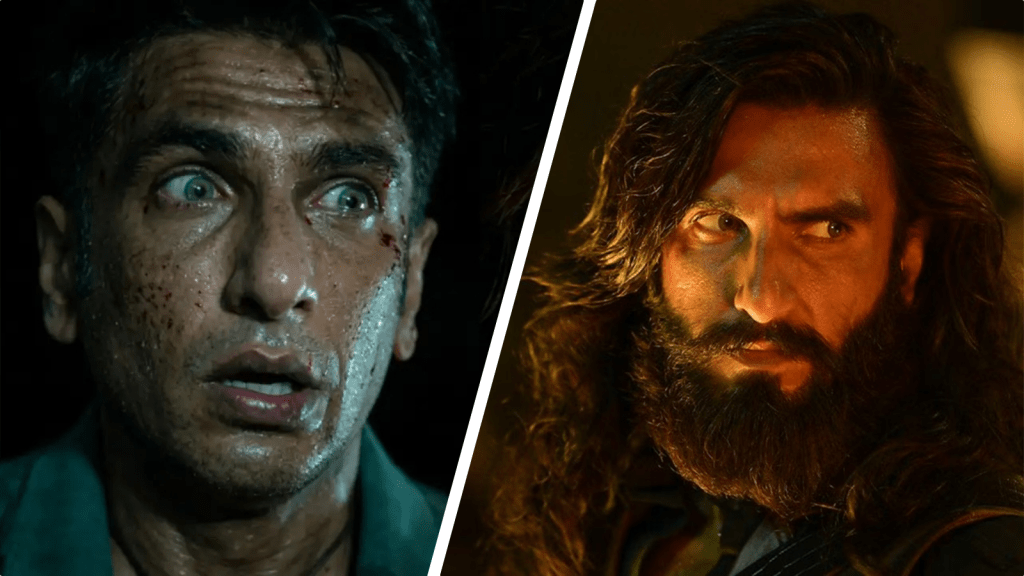
He has gone beyond being an actor in this movie. He is a chameleon.
The first half hour shows him as Jaskirat in the year 2000 and there is absolutely no trace of Hamza there. It’s like he is another person. The military haircut explains the face looking different. But the rest…he changed everything – his modulation, his eyes, the way he walks, talks, stands…
Who the hell changes the way a person stands, for God’s sake?
And right after the flashback comes a scene with Aalam. There you see glimpses of both Jaskirat and Hamza. Not sure how he pulled that off, but I genuinely saw both shades. After that, except for the interval, it’s all Hamza through and through. Even during the fights, even during the chaos…he remains Hamza. And then, in the final scene…he becomes Jaskirat again.
I genuinely didn’t see Hamza in that moment.
Also, truly appreciate the fact that he didn’t go for the usual physical transformation route. No extreme bulking or toning like what we saw with Rana Daggubati and Prabhas in Baahubali. His face was made to look broader with the beard and that ridiculous amount of hair (which, honestly, women would kill for), and his body was made to look bulkier through costume design. Strip that away, and you see a lanky frame with slightly hollow cheeks.
Interesting that through the whole movie, they never let the dignity of a woman fall. Any woman.
Even during the flashback, things were said. Never shown. For a director who didn’t hesitate to show a head being bashed in or blown off, this wouldn’t have been a stretch. But no. That’s a line Dhar chose not to cross.
And that restraint shows.
Hamza taking over Lyari was shown almost in fast-forward mode. The film clearly chooses momentum over depth here. The gang wars, Uzair’s role, Hamza’s planning. Everything moves at a sharp pace. It works for the narrative, but you do feel the compression. But what lands beautifully is why Hamza stays close to Uzair and not Rehman.
“Bhai hai tu mera.”
That’s the line. That’s the emotion. That’s the hook. Uzair trusts that emotion. And that trust is exactly what Hamza builds and uses.
Another thing the film gets absolutely right is it never turns Hamza into a one-man army. This entire mission is not built as a solo act. And that’s what makes it believable. There’s Rizwan. There’s Aalam. There’s the Baloch army and their head. There are people working on the ground in India.
Hamza is at the center of it, yes. He is the mind, the strategist, the one pulling the strings on the Pakistan side. He is part of the action when needed.
But he is never alone.
Execution is always a team effort.
And on the other side, Sanyal and Bansal mirror that with their own planning and people. It’s not hero vs system.
It’s system vs system.
And that balance is what keeps the film grounded. Even in the end, when Hamza hands over the book to Rizwan with a quiet Jai Hind, it doesn’t feel like a climax. It feels like a handover.
Like the mission was never his alone to begin with.
Another thing the film gets right is it doesn’t pretend Jaskirat was born this way. Hamza is made.
And not just through physical training. We see the psychological conditioning. The medical awareness. The way information is layered into him methodically, deliberately. He doesn’t walk into Lyari as a know-it-all. He walks in prepared.
He doesn’t befriend Uzair because he’s instinctively sharp. He does it because he’s been taught where to look at emotional weak links, at personal equations, at the spaces people don’t guard.
He knows Rehman not because he has figured him out on the fly, but because he has been fed everything how Rehman became who he is, what feeds his ego, what triggers it.
Even the violence is not random. Every move feels chosen. Because not every opponent needs the same weapon.
That’s the difference between a man who fights…and a man who is built for it.
And then comes the most surprising choice of all – zero romance.
We see Yalina. We see her pregnancy. We see their son. All of it plays out in a song, intercut with Hamza’s rise as Lyari ka Baadshah.
And yet…you never miss the romance. Not once do you wonder if something is lacking.
Because the bond is there. Just not in your face.
It’s in:
- her subtle nudge in the crowd
- her quiet caution – Hamza, careful, there’s our kid at home
- his softened stance in front of her
- that hard, scanning gaze that softens for just a fraction of a second when it lands on her
- Their confrontation where he bows to her but refuses to surrender and she quietly says – you need to move quickly.
That shift…that one fleeting moment…That’s where the romance lives.
And that’s where Ranveer Singh goes to another level.
As for the plot…keeping the slightly rushed gang war aside, it all comes together extremely well. The surgical strike is mentioned but not dramatized. And honestly, that choice makes sense since we already have an entire film dedicated to that event. Here, it’s just a moment. A reaction.
And what a reaction. A brief flash of surprise…followed by satisfaction.
And then comes the unraveling. One small detail. One shift. That’s all it takes.
That’s the one moment where Jaskirat breaks through Hamza…when he opens the door for Aalam and tries to explain. And Aalam, with his rapid reasoning, forces him right back into character.
Behind all of this are the two men who created Hamza – Sanyal and Bansal.
R. Madhavan…take a bow.
From “abba nahi maanenge” in 3 Idiots to “tera baap bhi maanega” here…you’ve come a long way.
With the makeup, he looks less like himself and more like Ajit Doval. But it’s the performance that lands. The smug satisfaction, the pride in “mere babbar sher,” the absolute certainty when he says Hamza won’t crack. And that push when he meets Hamza – don’t hold back. Unleashing Hamza.
And then…Jameel Jamali.
Rakesh Bedi absolutely owns every scene.
That forced laugh. That fake sympathy. That constant “mera bachha” You know it’s fake. The person hearing it knows it’s fake. And yet…it works. Every single time.
That small correction “mera bachha…mera damaad hai” had me laughing, but also thinking…Good. Hamza is safe. Because we know what “mera bachha” usually leads to.
Four hours of runtime. Didn’t feel like it. Yes, a few trims could have helped but that’s an observation, not a complaint.
The final reveal? Earned claps. Whistles. The works.
And I know I’ll react the same way when I watch it again.
By the end…you’re not looking for the actor anymore. Because the man he became has already taken his place.
The Storyteller's Lens
For the scenes that linger and the words that echo
4 responses to “Dhurandhar 2 – Not a hero. Not a performance. A design.”
-
Very well written, Suvika. I too feel Ranveer Singh was at a peak here. Quite the shift, Hearthrob to Hamza. I do feel like the momentum was a bit too fast in the Lyari gang war plot arc, just because of the number of artistic shots that they skipped through like a montage. I think that connects to the movie length. Rather than trim it down further, I think it would have been better to refocus the movie to fewer points given the original film length of 7 hours.
The ending shot was a masterpiece imo. Beautifully depicted the meaning intended regarding a soldier / spy’s life.
-
Now I’m going to be chuckling every time I hear – Ra ra Rusputin Lover of the Russian Queen 😀
LikeLike
-
I love this without any spoilers. I don’t know if there any actor or movie that had such a wide range … And get it all seems to be done so well.
U never answered the question everyone is asking … Is 2 a let down or it lived up to the expectations ?
LikeLike
-
It didn’t try to live up to expectations. It just did its own thing and that worked for me. And I did answer the question – in 1200 words here and a few whistles in the theatre 😉
LikeLike
-


 The Storyteller's Lens
Leave a reply to Suvika ST Cancel reply