He wasn’t made to fight. He was built to finish.
Now moving on from Ranveer Singh becoming Jaskirat and Hamza, let’s talk about Dhurandhar: The Revenge – the film itself.
The Music
First…the music. Both the songs (few as they are) and the background score operate on a completely different level.
There’s a gang war unfolding on screen…the audience wincing at the gore and in parallel, feet tapping to the beat behind it. There’s an intense torture scene, and I’m wondering if Hamza is going to make it out alive…while my body is swaying to Ra Ra Rasputin.
Unbelievable!
And that final song paired with Jaskirat’s eyes carrying a flood of emotions had the entire theatre going quiet. People blinking. Swallowing.
He just stands there…watching his family. The family he left behind. The family he now desperately wants to reach out to. And realizes…They’ve moved on. That he cannot go back and disrupt that life again. That he belongs nowhere. Not as Jaskirat. Not as Hamza.
That quiet selflessness? That hits.
Jaskirat: The Origin
Which brings me back to the beginning. Jaskirat’s war is not about Pakistan. Not about terrorism. It’s local. Personal. Brutal. A village strongman. Political power. A farmer’s family destroyed. Father killed. Sister murdered. Another abused and locked away. Police refusing to act. Every door closed.
He is not choosing violence. He is pushed into it.
And it shows in those eyes. Desperation. Rage. Fear. Pain. All laid bare.
A Morally Complex recruitment
So when Sanyal and Bansal approach him, his first instinct is not loyalty. It’s distrust.
“You’re asking me to trust the same system that didn’t lift a finger?”
And that’s where the writing becomes interesting. They don’t convince him with nationalism. They reach for something deeper: his lineage and his desire to serve like his father and grandfather.
They don’t erase his past. They reframe his future.
From Transaction to Commitment
Even after joining, Jaskirat doesn’t become Hamza overnight.
His plan is simple:
Infiltrate. Pass information. Get out. Go back to his family.
That thought never leaves him. Until…
He sees what he cannot unsee. The scale. The depth. The damage.
Weapons. Drugs. Fake currency. Terror.
And that’s when the shift happens. Not loudly. Not dramatically. Just a quiet, decisive realization shared with Aalam.
That there is no going back. That this is now permanent.
Politics + Terror
The film handles the intersection of politics and terrorism with surprising control.
Hamza doesn’t just navigate it. He controls both sides of it
No wonder Sanyal says: “Mera babbar sher.”
Babbar sher indeed.
Uzair – The Real Masterstroke
What truly stands out is how Hamza plays Uzair.
Dhar does something very clever here.
He doesn’t write Uzair as:
- naïve
- or smart-but-outplayed
Instead, he changes Uzair’s state:
- Grief → loss of Rehman
- Anger → triggered and directed
- Adrenaline → unleashed in gang war
- Fear → consequences closing in
And at no point does Uzair feel like a puppet. Every decision feels like his.
But the environment? That is constructed by Hamza.
Most would call the gang war the turning point. It isn’t. The turning point is fear.
Because fear creates dependence. And a dependent Uzair is exactly what Hamza needs.
The Throne
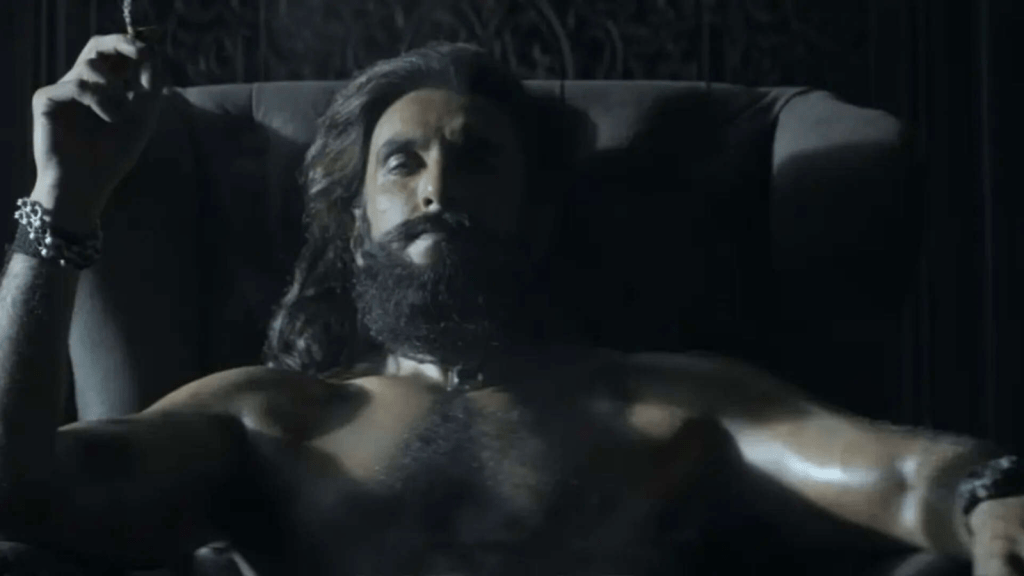
So when Hamza finally walks up to the throne…it doesn’t feel like a twist. It feels inevitable. He removes his shirt. Walks forward. Sits. No six-pack. No stylization. No body display. Just…a man.
A very normal-looking, extremely fit man with chest hair and zero theatricality.
And yet the theatre erupts. Because by then, the authority is already established. The body doesn’t matter. The presence does.
A deliberate choice by the director and cinematographer and a fantastic break from the typical male lead mold.
Yalina
The scene with Yalina stands apart. It’s stark. Emotional. Unavoidable. For the first time, we see the lines blur for Hamza. He doesn’t just play a role here. He feels. Because he loves her not as Hamza, but as Jaskirat.
And for a moment…he cracks. Not loudly. Not dramatically. He breaks. He allows himself to feel. But not long enough to change. Or surrender.
Instead, he sits down. Cross-legged. Palms joined. Calm. No raised voice. No patriotic speech. No “me or my country” rhetoric. Just…truth.
On one side: love, pain, betrayal
On the other: love, pain… and a quiet appeal to understand
No performance. No manipulation. Just a man who knows he cannot undo what he has become. And a woman who realises that despite the truth, her love isn’t going to go away.
Violence: Chaos vs Precision
Another interesting contrast:
- The gang war → chaotic, raw, uncontrolled
- The Baloch vs Mujahideen sequence → precise, methodical
Same violence. Different intent.
Relentless Motion
This film reminded me of Kill Bill. Not in style—but in rhythm. Relentless forward motion. No lingering. No emotional pauses. Just progression.
Even the interval points of both parts leave Hamza (and the audience) on the edge. Literally.
Aalam’s Death
Aalam’s death might seem avoidable. But it works. Because unlike the other kills, this one isn’t planned. And layered into that moment is something deeper:
He killed his sister’s husband
His once best friendThat’s enough to disrupt even the sharpest mind. The hesitation and the stumbling makes sense.
The Masterstrokes
Three moments stand out:
1. Bade Saab scene
That brief flicker in Hamza’s eyes…shock, recognition and then control. Very similar to his reaction on 26/11 yet very different.“Ghoorta hai meri tarah… bahut door tak jaayega.
Smooth. Very smooth.
2. Major Iqbal (Arjun Rampal)
Consistency in character.
No fear. No pleading. No repentance.
Even in death only conviction. And the only crack in his armour – fury directed at himself – because the guy he trusted the most made a fool out of him.3. Jameel Jamali (Rakesh Bedi)
The googly. That constant “mera bachha”…
Turns out it was him saying, “abe mein tera baap hoon.”A reveal that lands with laughter and disbelief.
What Didn’t Work
A few things could have been tighter:
- Excessive use of swear words that were distracting in key scenes
- Training sequence split awkwardly (clearly for post-credits)
- One melodramatic kill with forced patriotic chant that felt unnecessary
- Ram Mandir reference that was completely out of place
Final Thought
At its core, this is a no-holds-barred film about what happens when a country’s patience runs out and it decides: ENOUGH. No more restraint. No more waiting. No more absorbing.
What follows is just…EXECUTION.
The Storyteller's Lens
For the scenes that linger and the words that echo
 The Storyteller's Lens
Leave a comment