From romance to restraint — my changing equation with Shah Rukh Khan
I don’t enjoy most romances.
They need to have something more…conflict, context, consequence. Love alone, with random drama stitched around it, doesn’t work for me. Maybe that’s why my relationship with Shah Rukh Khan has always been… complicated.
I know what he represents. I know what he means to Hindi cinema. I understand why entire generations grew up believing in love because of him.
But films like Kuch Kuch Hota Hai never worked for me. In fact, I remember my WTF thought in the theatre the moment the “transformation” happened—the long hair, the sarees, the sudden shift into what we were expected to accept as love. It didn’t sit right with me then. It still doesn’t.
Even Dilwale Dulhania Le Jayenge, iconic as it is, felt more constructed than lived-in for me. The emotional choices felt too convenient for something that should have carried more weight.
And yet…
Today, I find myself drawn to Shah Rukh Khan more than ever.
The Shift
Somewhere along the way, both of us changed.
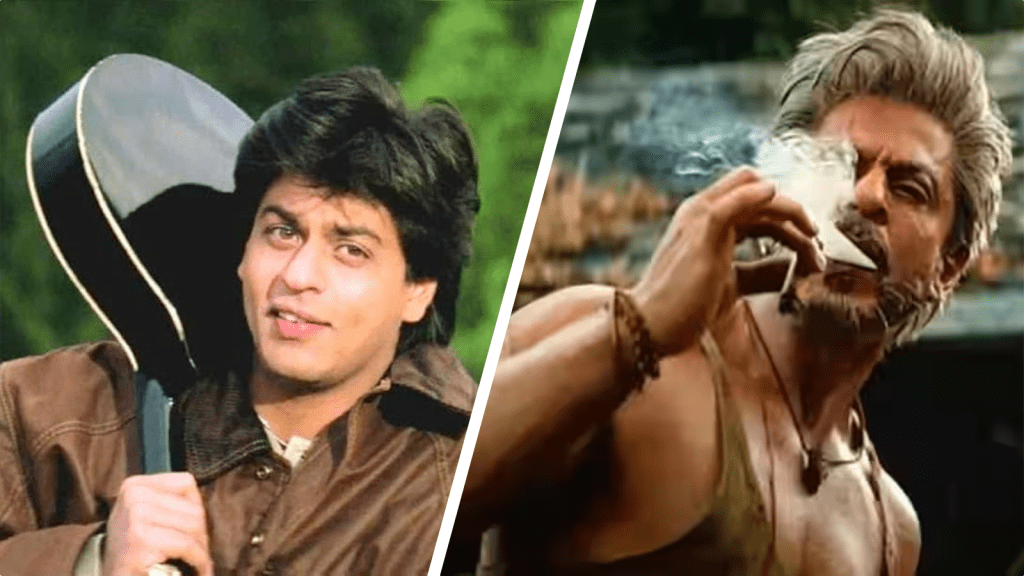
The Shah Rukh Khan of the 90s and early 2000s thrived on emotional openness. His characters loved deeply, expressed freely, and wore their hearts on their sleeves. That was his strength. It was the audience’s connection to him.
But the Shah Rukh Khan of today operates very differently.
He doesn’t offer emotion easily anymore. He contains it.
Whether it’s Swades, Chak De India, or even his more recent commercial outings like Pathaan and Jawan (their plots and storylines notwithstanding), there is a noticeable shift in how he holds himself on screen. The emotion is still there. But it’s measured, controlled, almost withheld.
And strangely, that makes it more powerful.
The Intelligence Behind the Actor
What makes this evolution interesting is that it doesn’t feel accidental.
I see Shah Rukh Khan as an actor who is incredibly intelligent. Someone who understands not just performance, but positioning. He doesn’t take himself too seriously. He can laugh at himself, crack jokes about his own roles, and allow others to do the same without defensiveness. That kind of ease comes from clarity…of who he is and what he brings to the table.
He knows his limitations. And more importantly, he respects them.
He doesn’t venture into spaces where his skill set doesn’t extend. And after all these years, even directors seem to instinctively know what works for him and what doesn’t. Someone like Ashutosh Gowariker would choose him as Mohan in Swades, not Bhuvan in Lagaan. The alignment matters and he has built a career on understanding that alignment.
At the same time, he leans into what he does best.
His vulnerability has always been his strongest asset. He expresses emotion without hesitation or guardedness. Audiences respond to that instinctively. Even in areas where he isn’t naturally built for, like action, he adapts. He often adds a touch of humor, a certain lightness, which makes the performance feel more believable rather than forced.
And then there is something else. Something that often goes unspoken. A certain… chivalry.
I’ve rarely seen him disrespect women in his films, even in moments written for comedy. There is a consistent sense of care in how he engages with his female co-stars both on and off screen. He is measured in what he says, how he says it, and how he positions the women around him.
And that shows.
Chemistry, Not Repetition
One of the most fascinating aspects of his performances is how he recalibrates himself depending on who he is paired with.
With Preity Zinta, he could portray a flat, emotionally distant marriage in Kabhi Alvida Naa Kehna and then turn around and embody unwavering devotion in Veer-Zaara.
With Rani Mukerji, the same actor could create intense, morally complex chemistry in Kabhi Alvida Naa Kehna and yet share a completely different, almost protective / paternal dynamic in Veer-Zaara.
With Kajol, the chemistry has always felt instinctive…effortless, almost like a shared rhythm.
The only pairing where I personally felt a slight disconnect was with Priyanka Chopra. The chemistry existed, but it felt… contained. Perhaps that was a creative choice. Or perhaps something else. It’s hard to say.
But that’s the thing with Shah Rukh Khan—when he holds back, you can feel that too.
From Love to Purpose
Earlier, love defined his characters. Now, purpose does.
That’s the biggest evolution I see. Not just in him, but in how his characters exist within a story.
He is no longer the man asking, “Will you love me?”
He is the man asking, “Will you stand with me?”That difference matters.
Because love, in his earlier films, was often the destination. Now, it feels like a layer…something that exists within a larger narrative of responsibility, conflict, and consequence.
And that’s the kind of storytelling I connect with.
Why This Version Works For Me
I’ve realized that I don’t reject romance. I reject romance without weight.
I need relationships to emerge from friction—through choices, mistakes, and consequences. I need the characters to carry something beyond their love story.
That’s why a film like Rocky Aur Rani Kii Prem Kahaani works for me. The romance isn’t floating on its own. It’s rooted in family dynamics, ideology, and identity.
And that’s exactly where Shah Rukh Khan seems to have arrived today.
He’s no longer trying to recreate the lover boy. He’s stepping into roles where age, experience, and emotional restraint become strengths.
Even in action-heavy films, where the plots may be exaggerated, he brings a certain weight to the character…a sense that this man has lived, lost, and chosen his battles carefully.
Full Circle
Maybe Shah Rukh Khan didn’t change. Maybe I did.
Maybe I just grew into a version of him that I couldn’t see earlier.
Or maybe…
He stopped trying to be the man everyone fell in love with and became someone far more interesting.
And somewhere along the way, I started paying attention.
The Storyteller's Lens
For the scenes that linger and the words that echo
 The Storyteller's Lens
Leave a comment