Reflections on Sita Ramam
I avoid tragedies. I always have. I can read anything, watch anything…except stories that end in loss. And yet, Sita Ramam made me sit through its ending not once, not twice, but three times.
The narrative choice itself is audacious. The story of Ram and Sita isn’t handed to us—it’s assembled, fragment by fragment, through memory, testimony, and absence. Afreen’s reluctant journey becomes our entry point. A girl from Pakistan…the granddaughter of Major Abu Tariq…with resentment and anger in her heart comes to India in search of Sita with extreme reluctance. For her, it is a useless chore thrust upon her by her grandfather…one she must complete only if she wants access to his money. And that is to deliver a letter written by Lieutenant Ram to Sita. Afreen along with Balaji, begins her journey to find Sita. Every person they meet gives them a piece of the past.
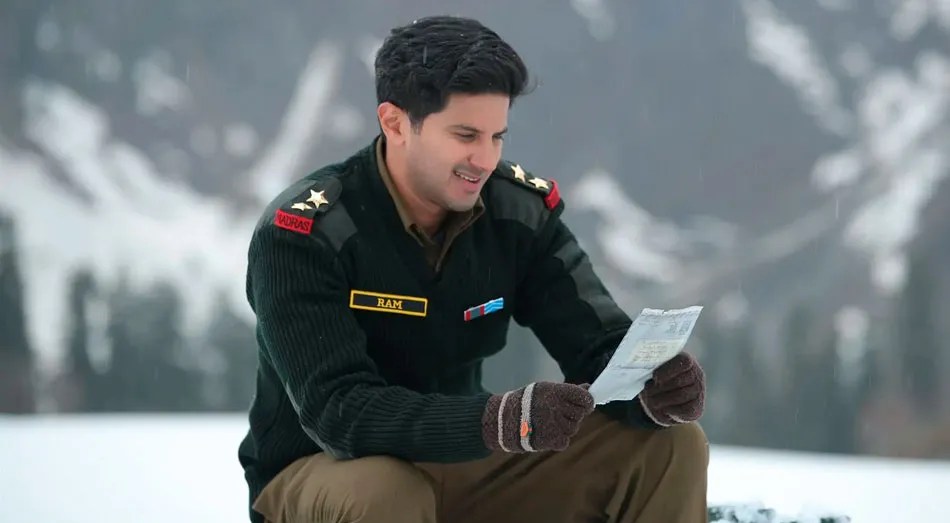
On paper, this structure should fracture the film. In execution, it does the opposite. Because Ram doesn’t arrive as a flashback. He emerges. Each person Afreen and Balaji meet adds a brushstroke, until suddenly there he is! Fully alive, breathing, smiling, standing quietly in the snow.
Sita Ramam gives us one of the gentlest male protagonists modern Indian cinema has seen. Ram is not written to impress or designed to dominate the frame. He doesn’t perform masculinity…simply inhabits integrity. A man with no family who smiles when he says it. A soldier who looks for ways to avoid bloodshed, not because he fears death but because he values life. A man who answers letters all night, not out of duty, but because being claimed even by strangers fills an ache he didn’t know how to name.
That bemused frown when he reads the first letter from “his wife”? That’s not confusion. That’s wonder. He falls in love without entitlement. He doesn’t know her face. He doesn’t know her status. He doesn’t even know if she’s real. Yet when he finds her, he steps back. Calls her Sita Garu. Holding space instead of hands. Inviting, never pushing.
Any other actor might have tipped Ram into naïveté or sentimentality. But Dulquer Salmaan plays him with grounded grace. This Ram is emotionally adult without being jaded, tender without being fragile. It feels less like watching a man fall in love and more like watching a man learn how to deserve it..
Sita might have fallen for him first. But it was Ram who fell harder.
Sita / Noorjahan. Mrunal Thakur doesn’t just play a princess; she plays a woman standing at the fault line between duty and desire. Her tragedy isn’t privilege. It is a constraint. Every smile she gives Ram carries a question behind it. Every step toward him is also a step away from the life scripted for her. What makes Sita unforgettable isn’t her sacrifice. It’s who she sacrifices for. Towards the end, as she is walking away…shedding the role of a princess, her brother asks her – do you know what you are losing for whom? She replies – you wouldn’t say it if you knew the kind of person I’m doing it for.
She lies to protect him. And maybe a part of her treasured the fact that he loved her as herself. Not her title or privilege. Just her. Sita. The dance teacher who taught a princess. And her attempt to walk away from him was to save him from a future where he would always be less than her title. And when she chooses to become Sita for Ram…it isn’t romantic escapism. It’s a renunciation.
Afreen / Waheeda. She is the skeptic who learns to believe. Her arc is the soul of the framing device. She starts as cynicism incarnate. Raised in inherited anger, taught that identity must always have an enemy.
And then Ram dismantles that worldview without ever meeting her. Her transformation is quiet. Incremental. Earned. From suspicion to disbelief to reluctant admiration to desperate hope. By the time she wants that letter delivered more than she wants closure for herself, by the time she hugs Sita and whispers her question in a tremulous voice – is Ram alive? we understand: Ram didn’t just love Sita. He restored faith. And Rashmika Mandanna plays this shift beautifully—never forcing the emotion, letting the cracks appear naturally.
Sita Ramam does that thing very few love stories dare to attempt and even fewer succeed at. It doesn’t seduce you into love. It envelops you in it. Quietly. Patiently. Almost politely. And before you know it, you’re surrounded…breathing it in, believing in it, aching with it.
What do you even call something like that?
It isn’t romance in the conventional sense. It isn’t longing. It isn’t even tragedy, though tragedy claims it in the end.
It’s devotion. Untainted, unclaimed, unconsummated. Love that exists before touch and survives without it. Not a “be mine.” But “let me be part of your world.” And perhaps that’s why the tragedy doesn’t feel cruel. Because Ram, even in loss, wins.
That’s not just love. That’s dasoham!
 The Storyteller's Lens
Leave a comment